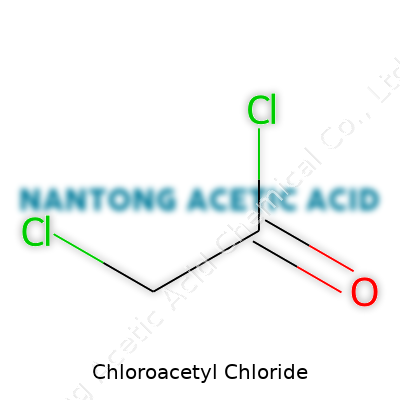
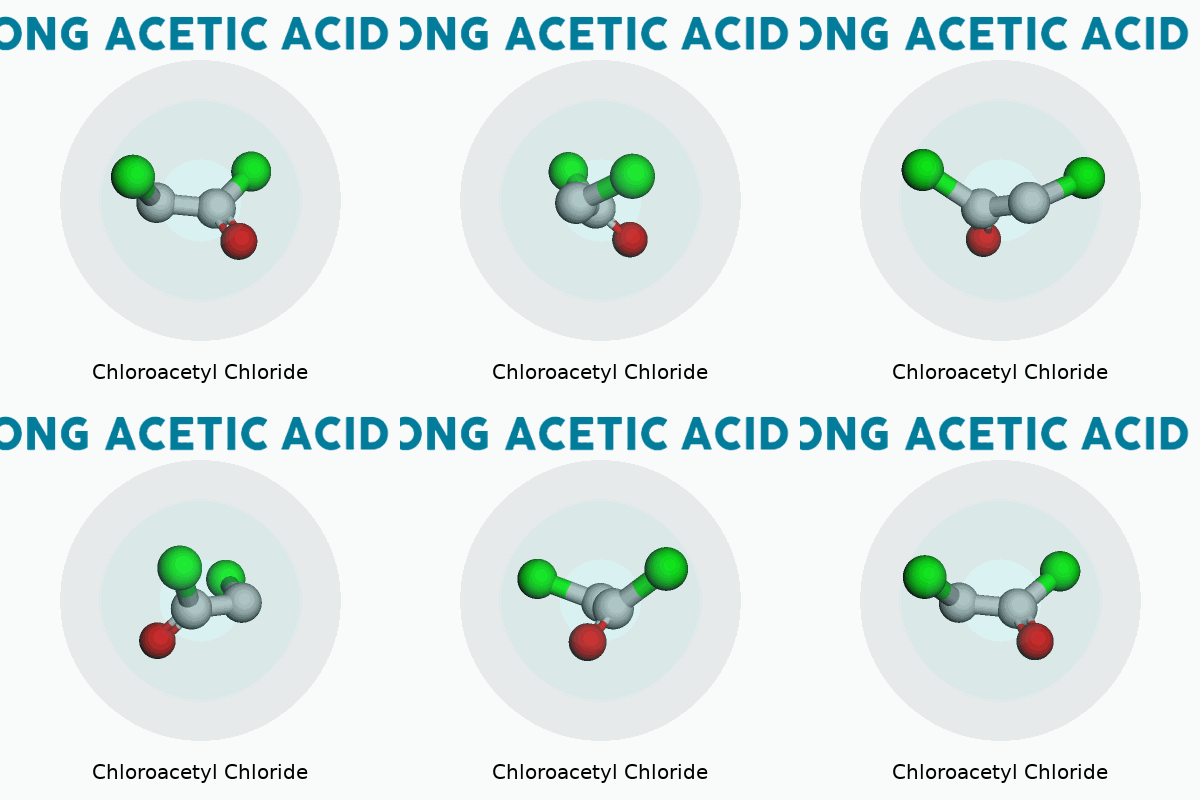
Tracing the roots of chloroacetyl chloride brings up the intersection between foundational organic chemistry and industrial progress. Chemists in the late nineteenth century realized that simple molecular changes carried big industrial consequences. Chloroacetyl chloride started drawing attention once manufacturers needed specialty chemicals for producing dyes, medicines, and herbicides. This isn’t just another reagent from the dusty pages of a chemistry textbook — it's a marker of how industry evolved by harnessing reactive intermediates that could transform whole processes. The push for efficiency and scale in chemical manufacturing shaped safety protocols and commercial distribution along the way.
In my own experience as a lab-based researcher, I’ve had to respect the bite behind this clear, colorless-to-yellowish liquid. Chloroacetyl chloride’s sharp, acrid odor signals its corrosive strength. Dripping it onto a workbench, I once watched puffs of vapor rise before the acid stung my eyes. That’s the reality of dealing with a chemical that boils at about 105°C and has a density higher than water. This stuff doesn’t just evaporate calmly; in humid air, it reacts fast, releasing clouds of hydrogen chloride. Chemists and technicians see it as a strong acylating agent, but plenty of folks only remember it for the sleepless nights spent ventilating labs and triple-checking bottle closures. Its directness in the lab lies in its physical traits: it eagerly donates its chloroacetyl group, and it reacts with water, alcohols, and amines, making it a real workhorse for synthetic applications.
I’ll admit, the technical grade or purity printed on a drum doesn’t thrill most people. Yet those numbers, often above 98%, mean more than meeting a sales contract. Impurities—even in trace amounts—unleash dangerous or unexpected byproducts. I once saw a minor batch impurity trigger a run of rejected pharmaceuticals. With the chemical’s volatility and reactivity, packaging and labeling come under heavy scrutiny. Regulators expect detailed warnings about toxic gases and correct UN hazard codes, not as a formality but as a message to every handler: careful handling isn’t optional here. Packing and labeling standards do more than check legal boxes; they build trust in the chemical supply chain from the very start.
Most production starts with monochloroacetic acid treated with thionyl chloride or phosphorus pentachloride. These reactions don’t just yield product; they spew out gases that need scrubbing. The smell of SO2 and thionyl chloride lingers with anyone who’s cracked a reactor open too early. In an academic setting, I’ve seen postgrads get creative, running small-scale syntheses inside fume hoods littered with water-absorbent trays to trap corrosive vapors. It’s not glamorous, yet each run teaches patience, and every shortcut tempts fate with ruined batches. Lab workers develop a healthy respect for reaction rates after mishaps where hydrolysis meant both lost yields and emergency neutralizations.
No single reagent makes a reputation on its own; chloroacetyl chloride earned its stripes through acylation, alkylation, and halogen exchange. It opens doors in medicinal chemistry, not because it “enables innovation,” but because it binds onto amines or alcohols with minimal fuss, slapping on a chloroacetyl group wherever it goes. Derivative work makes herbicides like alachlor and certain antibiotics possible. During my stint supervising a pharmaceutical pilot plant, we couldn’t substitute another acylating agent without sacrificing both selectivity and yield. That’s the tough tradeoff: chemistry rooted in practicality, chosen not out of preference but necessity.
The world of specialty chemicals can get confusing fast, with one substance running around under several names. In paperwork, chloroacetyl chloride carries tags like monochloroacetyl chloride or 2-chloroacetyl chloride. In the US or Europe, customs declarations and shipping manifests will sometimes swap these terms. These aliases don’t just add confusion—they highlight how chemical supply chains snake across borders, and practices vary in recordkeeping, assignment, and compliance. Talking shop with suppliers demands fluency in all these labels, else crucial details slip through the cracks in translation.
Chloroacetyl chloride’s hazards aren’t theoretical. I’ve witnessed colleagues in basic research underestimate it, only to land in urgent care with chemical burns or breathing trouble. Short-term exposure can kick off severe respiratory irritation or skin blistering in minutes. Even its containers punish careless handling; a faulty seal quickly sets off alarm systems. Modern manufacturing floors rely on tight engineering controls—total enclosure reactors, neutralization tanks, and round-the-clock air monitoring sensors. Strict personal protective equipment isn’t just for show; it keeps accidents from becoming newsworthy events. Emergency drills in facilities using chloroacetyl chloride aren’t just regulatory hurdles. They save lives, and I’ve seen more than one near-miss turn into a lesson about double-gloving and face shields.
Talk to anyone in agrochemicals or pharmaceuticals, and they’ll recall some product that spun out of a chloroacetyl chloride process. Its use in synthesizing the ‘warrior crop’ herbicides, or boosting yields of cephalosporin antibiotics, continues to justify its spot on factory floors. These aren’t abstract market segments; they’re the backbone of modern health and agriculture. As a chemical intermediate, it sneaks into everything from pain relievers to specialty dyes. Consumer products don’t carry any of its tang, but without its role as a precursor, supply chains break down fast. I’ve watched the ripple effects when a plant shutdown—due to safety audits—drove up costs for months across dozens of industries.
Lab researchers keep probing for smarter ways to tame and transform this reactive molecule. Safer derivatives, better catalyst systems, and greener processing routes turn up in the literature each year. In my own work, developing protocols with less hazardous byproducts mattered for both cost control and worker health. The push for “sustainable chemistry” isn’t only about marketing; it comes from standing next to a fume hood and hoping the overnight reaction doesn’t melt the tubing. Universities and corporate labs chase down new applications, including custom reagents or specialty pharmaceuticals, looking for that edge that turns risk into return.
Public health studies and internal plant records provide plenty of data on what chloroacetyl chloride exposure can do. Most short-term effects hit fast: eye, respiratory, and skin burns, with severe lung damage possible on bad days. Longer-term, repeat exposure raises the specter of chronic bronchitis and potential carcinogenicity, though the evidence isn’t always clear-cut. Reading over decades of industrial toxicology, I’ve noticed that each generation learns the hard way not to trust yesterday’s safety margins. Improvements in ventilation, leak detection, and protective clothing didn’t happen overnight; they came from hard-earned experience and sometimes tragic mistakes. Plant operators now push for closed systems and smarter monitoring not only to hit compliance goals, but because the old ways just aren’t worth the gamble.
Chloroacetyl chloride won’t fade from chemistry or industry anytime soon. Its versatility in forming new carbon-nitrogen and carbon-oxygen bonds keeps it relevant in a landscape hungry for new drugs and crop chemicals. What could change: how it’s handled, who’s willing to take the risks, and which green alternatives rise up from labs to full-scale production. I see research pointing toward less hazardous methods, clever catalysis, and processes that recycle or neutralize the nastiest byproducts before they leave the factory gate. The chemical’s legacy depends not only on what it makes possible, but on how its dangers get managed and eventually, maybe, designed out entirely.
Chloroacetyl chloride lives behind the scenes, far from the average person’s dinner conversation, but it shows up more often than most would guess. Most people have never seen it, but this chemical sits in the supply chain for pharmaceuticals, pesticides, and dyes. The stuff isn’t glamorous – it’s corrosive, it smells sharp, and companies only use it if they’ve got no other option. Yet, without it, life would look very different.
Companies count on chloroacetyl chloride to kickstart reactions. Drug makers often choose it to help build antibiotics or cancer-fighting medicines. This chemical puts the “chloro” part into key molecules, giving new drugs their power. Chemists rely on it when working with compounds that can’t take shortcuts: certain medicines, once started down the pipeline, simply can’t be finished without this ingredient.
Factories that make herbicides and insecticides also lean heavily on chloroacetyl chloride. In agriculture, weeds and bugs challenge food production every year. By tweaking molecules with this reactive chemical, companies come up with precise weapons against those pests. It means farmers get more food out of the same ground—a concern that never goes away.
Working with chloroacetyl chloride brings a different headache. Inhaled or spilled, it causes burns that demand medical attention. Health and environmental safety aren’t afterthoughts; they dominate every step of its journey. Strict rules guide how people ship, store, and handle it. In my time talking with chemical plant engineers, even small mistakes draw big attention: spilled gas means evacuation drills turn into real emergencies, fast.
Regulators keep a close eye on facilities using this chemical. Violations carry steep fines, especially if leaks threaten water or air quality. Across dozens of nations, laws force industries to rethink whether the benefits of chloroacetyl chloride outweigh the risks. Research points out that some accidents happen due to rushed protocols or neglected maintenance—a fact that hits hardest in underfunded plants.
Alternative chemicals exist for a few steps where chloroacetyl chloride once held monopoly power. Some pharmaceuticals now swap in greener reagents, pushed by public demand and tougher safety standards. But replacement isn’t easy. Switching away from chloroacetyl chloride sometimes means redoing years of lab work, changing manufacturing lines, or accepting higher costs—barriers smaller companies feel most acutely.
For the moment, education and better oversight offer the surest gains. Better protective gear, frequent drills, and clear safety culture give workers a fighting chance if something goes wrong. On the environmental side, investments in scrubber technology and emergency containment help shrink the impact of leaks. Some regions fund research into less toxic alternatives, but breakthroughs come slowly where big money rides on proven chemistry.
Chloroacetyl chloride stands as a reminder that science and safety walk hand in hand. Modern medicine and agriculture owe a lot to what goes on in chemical plants behind locked doors. The price is vigilance and a constant push for safer ways to get the same job done. From my own experience talking with those who work in these industries, lessons lie here not just for chemists, but for all of us who count on a reliable, safe supply of the products that fill our medicine cabinets and kitchen tables.
Anybody who’s spent time working with chloroacetyl chloride learns right away that this isn’t just another bottle on the shelf. Its sharp, irritating smell hits first. Then comes the biting vapors. This chemical reacts strongly to water, even to humid air, releasing clouds of hydrogen chloride gas and corrosive fumes. That makes safety much more than rules—it's about keeping yourself and your coworkers out of danger.
With chloroacetyl chloride, it’s easy to underestimate the risks if you focus only on the liquid in the flask. Just a spilled drop meets air or a trace of moisture, and suddenly the room fills with toxic mist. Years ago I saw a storage bottle that hadn't been sealed tight enough. The cap’s threads corroded, and fumes ate through a metal shelf, leaving rust and stress behind. Even a whiff can cause coughing and nosebleeds; direct contact brings burning pain. That stuck with me.
Every bottle deserves a secondary container. Forget basic nitrile gloves; thick, chemical-resistant gloves and a proper lab coat form your first line of defense. Goggles don’t cut it—face shields keep the splashes from hitting you. Goggles fog up in the vapor anyway, so anything short of a full-face shield just doesn’t work. If there’s ever a doubt about the ventilation, it’s time to use the fume hood. No fume hood—no handling, period.
Chloroacetyl chloride turns complacency into mistakes. Some folks think they can transfer small amounts on the benchtop. All it takes is a beaker with a thin crack, or an unsuspected droplet of water, or a moment of distraction—and the cloud forms. Even pipetting becomes a hazard. I’ve seen accidents from badly fitted pipette bulbs or lazy sealing practices. I learned early that every tool touching this chemical needs to be dry, intact, and chemical-compatible. Glass syringes, plastic transfer bulbs—test for compatibility, don’t just rely on tradition.
Once the experiment wraps up, you can't leave waste behind in a sink or a regular bottle. If chloroacetyl chloride finds water, it reacts. The safest way to dispose of it means specialized containers and properly labeled waste. Nobody wants a dangerous surprise weeks later when a custodian or a new lab mate opens a waste cabinet.
Some of the safest labs I’ve worked in treat every session with this chemical as a serious event: written plans, spotters, and clear communication. Those environments taught me that protocols work best when they are lived, not treated as red tape. Fact-checking with material safety data sheets, attending chemical safety courses, and drilling emergency wash procedures until instinct takes over make a real difference. Showers and eyewash stations need to be measured for reach and function before any work starts.
Facilities need to prioritize proper storage—cool, dry, and away from anything that could trigger a reaction. Even the plastic wrap used to seal a cap can matter. I won't forget colleagues who kept careful logs on every transfer, so if something did go wrong, we all knew what to look for and how to act fast.
No chemical gives second chances, and chloroacetyl chloride proves it every time. Sticking to strict handling procedures, updating emergency plans, providing smart training sessions—these habits protect every hand in the lab. That's not just expertise—it's what keeps people healthy and jobs safe. And in the end, that's what matters most.
Chloroacetyl chloride isn’t something people take lightly in labs or factories, and for good reason. This clear liquid will let off strong fumes if it comes into contact with air, releases toxic gases with the slightest hint of moisture, and causes chemical burns at the drop of a hat. Seeing the bottle can make experienced chemists pause: they know a simple slip could send someone running to the emergency shower.
In the wrong spot, chloroacetyl chloride creates more problems than most chemicals sitting on the shelf. A single leaky container can spark a reaction with whatever water’s nearby—they remember the time a careless cap caused a yellow haze to fill a fume hood. People working with it wear coats and goggles for a reason. Most know the routine: double-check for leaks, never store above room temperature, and always keep away from anything wet.
Proper storage doesn’t just help meet compliance rules; it protects everyone in the building and even outside. Most folks rely on cool, dry, and well-ventilated chemical cabinets built with sturdy materials like polyethylene or coated steel. It never sits next to anything that can trigger a violent reaction—acids, bases, water, or even strong oxidizers. You never want chloroacetyl chloride as a neighbor to what could turn the room into a disaster scene. Every container should close tight, and labeling must be clear enough so any new hire or visitor spots the danger instantly.
Experience shapes wisdom. Many remember stories where a simple oversight made things dangerous. Once, a warehouse kept this chemical on a wooden shelf. Humidity warped the wood, causing a spill. If the storage space lacks climate control, the vapor alone can trip a fire alarm—or worse, land someone in the hospital. Instead, reliable chemical storage rooms use climate monitors and alarms. Emergency spill trays go under every drum, leaving no room for slow leaks to build up.
Fighting complacency is half the battle. New lab workers or warehouse staff might know the theory but only pick up respect for chloroacetyl chloride through stories, drills, and by seeing senior staff act with care. A locked chemical cabinet only works if everyone double-checks seals, avoids mixing up storage, and reports odd smells or drips as soon as they spot them. More places could hold regular refresher training and walk-throughs. Safety reminders on doors or cabinets don’t just tick a policy box—they plant seeds of caution.
Chloroacetyl chloride teaches a valuable lesson: shortcuts quickly become close calls. Strong habits, thoughtful storage, and open communication keep workplaces running smoothly. With everything in its right place, the risk shrinks to something manageable. Teams build trust by following the wisdom gathered from years of shared experience—not just numbers on a spreadsheet or rules from a manual.
People tend to overlook some of the nastier chemicals out there until a headline reminds everyone. Chloroacetyl chloride falls into that camp—those who’ve worked in chemical labs or certain factories probably felt a knot in the stomach just reading the name. Unlike more familiar threats like bleach or gasoline, chloroacetyl chloride takes danger up a few notches, especially once you know what it does to the human body.
During my early years in chemical research, I watched a colleague mishandle a container just once. Everyone knew what to do, but nothing quite prepares you for the panic when a few drops hit the lab bench. Chloroacetyl chloride doesn’t just irritate—it causes immediate burning of the eyes, skin, and lungs. People exposed to even a small whiff cough, gasp, and tear up instantly. Those working near production lines or in delivery roles have learned to double up on protective gear because of its power to invade any little crack or seam.
Health agencies don’t mince words. Chloroacetyl chloride is corrosive, meaning contact brings not just red, sore skin, but blisters and chemical burns that heal badly. Your eyes can get damaged so quickly that vision loss becomes a risk. I once watched seasoned workers organize drills, not as a formality, but because they’d seen chemical burns happen in real time. Even routine exposure, especially to vapors, can scar airways, make breathing nearly impossible, or set off a dangerous chemical pneumonia. The risks spike in warm, humid weather when the liquid releases toxic gas much faster.
On top of that, this chemical breaks down into hydrogen chloride and phosgene—both infamous for their own dangers. Hydrogen chloride burns the lungs and skin, and phosgene counts among war gases from the previous century. No one downplays the risk after learning what a single spill can unleash. Headlines about leaks at chemical plants aren’t just stories—they’re warnings that every worker takes seriously.
Over the years, people have invented all kinds of clever responses to the hazard. Relying on ventilation, splash shields, and chemical suits turns into a routine rather than a hassle. Facilities enforce showers and eyewash stations closer to actual work, cutting seconds off response times when accidents happen. Many companies write strict rules in plain language so no one misses the message—respect the chemical, or pay the price.
On the medical side, treating chemical burns from chloroacetyl chloride gets tricky fast. Washing the exposed area and seeking immediate help remains the only useful move. Once the fumes injure lungs or eyes, outcomes take a nasty turn if care isn’t immediate and aggressive. There’s no quick fix, just long recoveries and high medical bills. Legal standards push for closed systems and automatic shutoffs, focusing on removing human error from the equation as much as possible.
For those outside the industry, it’s tempting to tune out stories about niche hazards. Yet those working with chloroacetyl chloride see the bigger picture: every improvement in safety steps, every well-run drill, and every bit of clear labeling pays off. From scars and near misses to regulations with real bite, exposure risks can’t be shrugged off by anyone who’s seen the aftermath up close.
Chloroacetyl chloride doesn't show up in everyday conversation, but its reach extends far from the average chemistry lab. Here’s the deal: this compound comes with a chemical formula of C2H2Cl2O, sitting at a molecular weight of 112.94 g/mol. Simple as its formula looks, the stories tied to this molecule ripple through industries, drug development, and safety debates.
Every year, I see more chemicals linked with everything from medicine to crop protection. Chloroacetyl chloride springs up as a building block, especially in making pharmaceuticals and pesticides. Its reactive acyl chloride group and attached chlorine atom mean scientists favor it for making tougher bonds or weaving in new chemical functionalities during synthesis. A chemical like this sits at a crossroads—one fork leads to invention, the other to scrutiny.
I still remember fumbling through chemical catalogs as a student, seeing names like chloroacetyl chloride attached to promise and peril in equal measure. Drug designers reach for it when constructing molecules with precision. On the flip side, this compound stings, literally—it’s corrosive and sends sharp fumes into the air. Workers in manufacturing or handling labs keep gloves and goggles handy because a splash burns, inhalation chokes, and long-term exposure might spark bigger health problems.
Facts matter here. Chemical plants churn out chloroacetyl chloride on scale, feeding demands for herbicides and antibiotics. Take penicillin G, a widely used antibiotic—its production can run smoother or faster with intermediates made from this chemical. On the agriculture side, several herbicide syntheses turn to it as their linchpin. Without it, some processes grind to a halt or cost much more.
Yet, stories of chemical leaks and air contamination remind us—nobody can afford to get casual about safety. In 2022, a spill in India injured dozens and forced evacuations for miles around. Even after decades of best practices, one missed step does harm that lingers long after clean-up crews leave. I’ve seen community outrage up close; it always circles back to the same point: no industry should cut corners when people’s lungs, soils, or waterways are involved.
Switching to safer alternatives isn’t always possible, especially for specialized synthesis. So eyes turn to better engineering controls, airtight containers, and constant worker training. Automated handling and real-time gas detectors serve as frontline defenses. Beyond the chemicals themselves, what really saves lives is stubborn attention to detail and feedback from workers on the ground.
Some research teams chase new routes to old molecules, hunting fewer hazardous materials or closed-system setups that keep human contact low. I’ve watched industry culture begin to shift as more managers realize safety talks aren't a box to tick—they spark new ideas, too. Given that chemistry keeps unlocking world-changing products, the conversation can’t ignore the fallout from the tools we use along the way.
Chloroacetyl chloride, with just five atoms, carries weight far heavier than its molecular mass alone. For an industry that thrives on the next breakthrough, a little humility and a lot of vigilance make better headlines than another avoidable accident. Every chemical leaves a trace—how we handle them says as much about us as the science does.