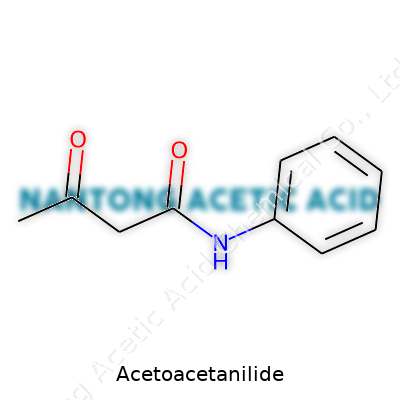
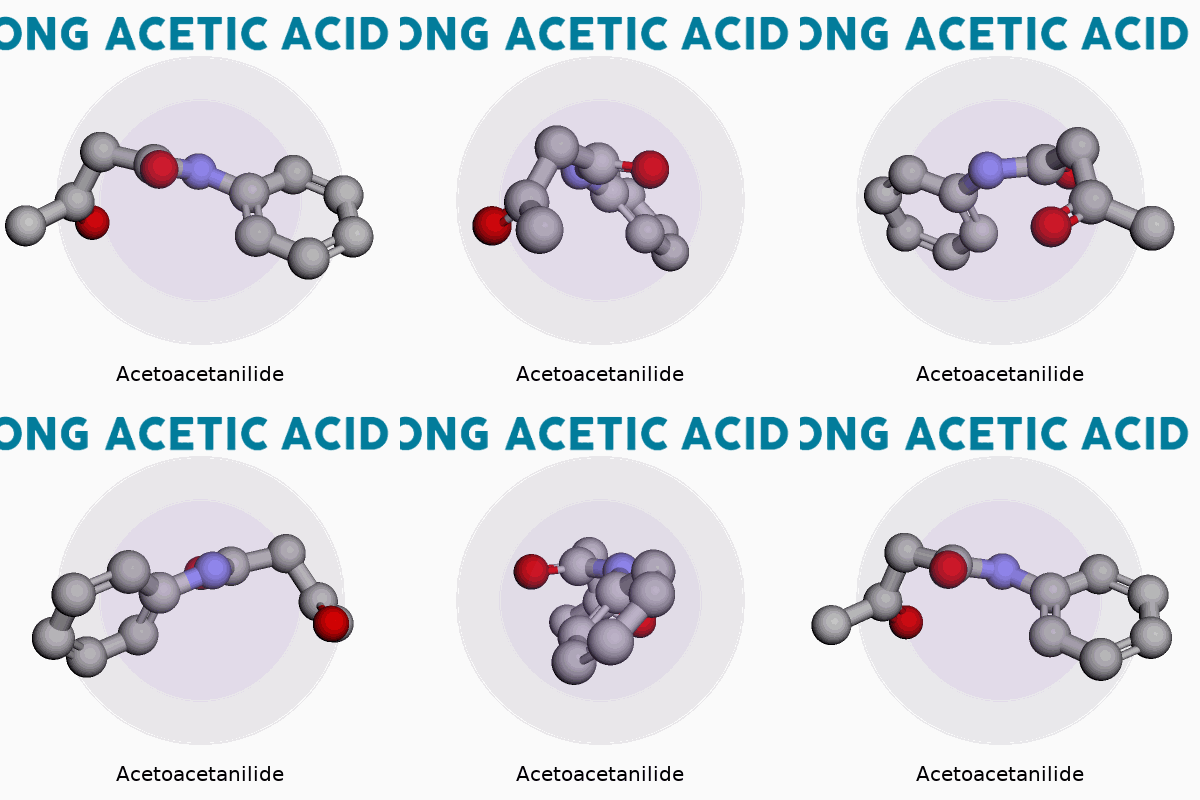
Acetoacetanilide stands as more than just an obscure compound in an organic chemistry textbook. Its story begins in the golden days of synthetic dye discovery, sprouting from curiosity about what aniline derivatives could offer beyond their established coloring capabilities. Early chemists set out to explore the vast field shaped by the Friedel-Crafts acylation, searching for building blocks with robust reactivity. Acetoacetanilide quickly found favor because its structural backbone—an anilide group coupled with a reactive acetoacetyl side chain—offered new reaction possibilities. This leap built connections between textile innovation, pharmaceutical experimentation, and broader transformations across the burgeoning chemical industry of the late nineteenth and early twentieth centuries. The rise of acetoacetanilide marked a shift from isolated experiments to a deliberate, methodical hunt for intermediates that could bridge the gap between raw materials and commercial products.
In the everyday world, acetoacetanilide typically appears as a dull white to pale yellow crystalline powder, modest in its looks but indispensable in certain manufacturing spaces. Its main hallmark is serving as an intermediate—one of those essential cogs that never graces the label of your favorite product but quietly enables entire industries. The dye sector leans heavily on it, especially in azo pigment production, but it’s not limited to just splashing color on textiles or plastics. Researchers dip into its reactive toolbox to craft pharmaceutical intermediates, and occasionally, academic labs pull it off shelves in the hunt for entirely new molecular shapes.
Anyone who has handled acetoacetanilide knows immediately that its crystalline form can cake up quickly if kept anywhere humid for too long. It doesn’t boast remarkable odor, nor do its crystals shimmer invitingly. Insoluble in cold water, it will dissolve a bit in hot water, showing more enthusiasm for organic solvents like ethanol or acetone. Its melting point usually lands north of 80°C, and that stability helps during industrial-scale purification. Looking at the molecular level, it has both the anilide group, with its characteristic aromatic ring, and a β-keto group that makes the molecule much more reactive than a regular anilide. This arrangement underpins much of its importance in synthesis: each functional group offers chemists a convenient handle for further modification or combination.
Looking at chemical supply, reliable vendors tend to package acetoacetanilide by purity, moisture content, and, less often, residual solvent level. Bulk shipments head out in HDPE drums to shield the powder from ambient moisture, while smaller research lots might arrive in tightly sealed glass or plastic bottles with standard labeling, emphasizing necessary precautions. Hazard codes appear plainly: harmful if inhaled or ingested, eye and skin irritant, and recommendations for PPE (personal protective equipment) for regular handling. The stability data invites users to store the product in a dry, well-ventilated spot away from acids and oxidizing agents, advice echoed in lab safety training across the world.
Most chemists learn about the core production method through the classic acetoacetylation of aniline. This process starts with the reaction of aniline and diketene or, alternatively, using ethyl acetoacetate in the presence of acid or base catalysts. Diketene offers efficiency, and industrial operators favor it for the high yields and reduced byproduct formation. Once the product crystals out, filtration and recrystallization kick in, ridding the end compound of stray reactants or colored impurities. As with many aromatic intermediates, careful control of temperature and pH throughout the synthesis deeply influences both quality and yield, reminding seasoned hands that reliable chemistry still depends on attention to the basics.
Acetoacetanilide doesn’t limit its talents to being an end product. Chemists return to its versatile β-keto and anilide groups to stitch together more complex molecules. Its star turn happens in coupling reactions. Ask any dyestuff chemist about diazotization and they’ll mention how pairing acetoacetanilide with a diazonium salt creates vivid, stable azo dyes in a rainbow of shades. Pharmaceutical researchers hunt for bioactive compounds by tweaking its aromatic ring, exploring substitutions or transformations that tease out new therapeutic behaviors. Those same modifications create custom tailor-made molecules for studying enzyme reactions, catalysis, or novel polymer materials. Each transformation builds on those same chemical features that first drew interest over a century ago—showing that invention often comes from working with what’s already at hand, but seeing it in fresh light.
In conversation and on lab labels, acetoacetanilide travels under a few distinct names: N-phenylacetoacetamide, 3-oxo-N-phenylbutanamide, and, less often, acetoacetic acid anilide. Older literature might call it acetoacetyl anilide, an echo from a period when conventions weren’t yet settled. Pigment companies seek catchier identifiers for certain grades, but those root chemical names assure everyone understands what’s in the bottle, no matter the brand.
Safe handling can make or break a long day in chemistry. Acetoacetanilide carries moderate health risks. Getting the powder in your eyes or on your skin can lead to irritation, so gloves and goggles aren’t optional but just part of daily routine. Inhalation presents a more subtle hazard—not as obvious as some noxious reagents, but enough of a respiratory irritant to earn fume hood placement during large-scale operations or weighing out the fine powder. Spills clean up easily because of its solid form, but every shop I’ve worked in keeps spill kits and eye wash stations just a few steps from any work involving hazardous powders. As with most lab and plant work, the greatest protection comes from training, attention, and respect for what chemicals can do if not used wisely.
Pigment creation defines much of the commercial demand for acetoacetanilide. Azo pigments, known for their brightness and durability, rely on this intermediate. Manufacturers use acetoacetanilide-based dyes for coloring plastics, printing inks, and textiles because they resist fading under sunlight and washing. Pharmaceutical scientists engage with its structure while designing prodrugs or intermediates needed for more complex synthesis. In research, it finds use as a building block in organic methodology studies, sometimes chosen for its balance between reactivity and manageable hazard profile. Polymer studies occasionally include acetoacetanilide as a co-monomer, hunting for fresh mechanical or chemical properties in the resulting plastic. Each application draws on a slightly different aspect of the molecule, exploiting the unique blend of the anilide and acetoacetyl portions, making this a textbook example of one compound playing many roles across diverse industries.
Research keeps pushing the envelope on what else molecules like acetoacetanilide can do. Synthetic chemists develop greener processes involving water-based media or milder catalysts, aiming to ditch older, harsher methods that linger from the past. Developing variants with different substituents offers new color profiles for pigments or alters reactivity for pharmaceutical leads. Academic labs treat acetoacetanilide as a launching point for teaching reaction mechanisms, exploring catalytic cycles, or creating sensors for metal ions. These ongoing projects create a virtuous cycle, where findings from the lab scale down into safer, more sustainable, and cost-effective ways to manufacture familiar products.
Toxicity hangs in the air whenever the word “chemical” pops up in public debates. For acetoacetanilide, the scientific consensus rates it as posing moderate hazard. Direct contact with skin, ingestion, or inhalation can provoke irritation or mild toxicity, but its risks don’t rival the dramatic effects of some older hazardous intermediates. Testing points to low bioaccumulation potential, though chronic exposure data still needs more depth. Studies in rats and fish suggest limited acute toxicity, but regulatory advice builds in buffers to compensate for what we don’t yet know. Best practices hold workers and researchers to a higher standard: limit exposure, use protective gear, prevent accidental release to the environment, and keep updated with ongoing findings from toxicology research.
Looking at what’s possible excites me most about acetoacetanilide’s future. Trends shift toward “greener” synthesis—less waste, more efficiency. Companies and universities focus on solvent-free reactions or use recyclable catalysts, part of a broader drive to shrink chemical footprints in manufacturing. Pigment demand remains strong, but digitization and smart materials call for functional molecules that can do more than generate color. Electronics, sensors, and advanced plastics benefit from tailored molecules, and acetoacetanilide’s chemistry fits right into the toolkit for developing these next-generation materials. As toxicity research yields better guidelines, its use could even expand into carefully managed pharmaceutical projects. In my view, everyday materials—from inkjet printers to solar panel coatings—will soon benefit from tweaks and improvements born in today’s research labs, where time-tested intermediates like acetoacetanilide still inspire new invention.
Every time I pass through the aisles at the hardware store, I’m reminded of the unassuming workhorses behind our daily world of colored plastics, coatings, and printing inks. Acetoacetanilide rarely grabs headlines, but its influence runs deep in manufacturing and chemistry. This compound, with its modest structure, has shaped how we see and use colored materials in modern life.
I first came across acetoacetanilide in a university organic chemistry lab, where its role seemed minor at the time. We often handled it as a starting material for synthesizing azo dyes. In practice, that small beaker in the lab mirrors its impact on an industrial scale. Acetoacetanilide forms the backbone for pigments that lend vibrant, lasting color to plastics, textiles, and printing inks.
The dye industry depends on it because it reacts well with coupling agents to create clear, stable colors. Products with lasting brightness—like packaging, automotive interiors, and outdoor signage—often draw their color from chemistry that starts with acetoacetanilide. Instead of dull, fading shades, manufacturers get rich hues that stick around. That’s not just a cosmetic choice; it means less waste and fewer touch-ups down the road.
From a technical perspective, acetoacetanilide brings versatility to chemical synthesis. Its structure lets it absorb other molecules easily, making it valuable for more than just color. Pharmaceutical companies sometimes use it as an intermediate to build more complex molecules. Its predictability in reactions translates into more efficient, consistent results in labs and factories alike.
This reliability means less trial and error in high-volume settings. With fewer surprises during production, both quality and safety improve. That efficiency saves companies money and keeps products more affordable.
Working in the chemical industry teaches both respect and caution. While acetoacetanilide helps deliver the colors and drugs we depend on, it requires responsible handling. Factories must follow strict safety and environmental rules to keep workers safe and to control potential pollution during manufacture and use. Research continues into making these processes even safer and more sustainable.
For example, some companies invest in closed-loop systems that minimize waste and reduce emissions. Others look for ways to reduce water and energy use during processing. Adopting greener solvents or improving filtration and disposal methods can go a long way.
Looking ahead, industries aim to use acetoacetanilide more efficiently. Ongoing research explores bio-based alternatives, better recycling techniques, and new reaction conditions that use less solvent or work at lower temperatures. Companies also focus on transparency, keeping better records and sharing information about sourcing and safety. More collaboration across sectors could spark breakthroughs in both performance and sustainability.
Acetoacetanilide may play a behind-the-scenes role, but its value runs through everyday products we rely on. Chemistry matters most when it can deliver color, stability, and reliability without leaving a mess. By investing in research, sharing knowledge, and staying grounded in strong science, the industry can keep finding ways to use acetoacetanilide smarter and safer for everyone.
Acetoacetanilide comes up in a lot of conversations among chemists, especially for those working on dyes and pigments. The structure of this compound, which chemists often call 3-Oxo-N-phenylbutanamide, holds more than what meets the eye. Under the microscope, you find a molecule built around a few simple groups: an anilide part that ties back to an aromatic benzene ring, connected to a butanamide backbone with a ketone at the third carbon. In plain words, imagine a benzene ring sitting at one end, hooked up to an amide link, and a four-carbon chain with a double-bonded oxygen. The chemical formula C10H11NO2 sums it up, but looking at it that way misses the practical importance.
Labs across the world rely on acetoacetanilide for what it gives them: a jump-off point for big, high-value reactions. I remember tracking its use in pigment design projects back in university. One thing always stood out—this wasn’t just an arbitrary raw material. Its structure made it favorable for coupling reactions, especially when making azo dyes. These dyes end up in everything from the color on our fabrics to the ink in our pens. It’s the reactive methylene group, tucked between the ketone and the amide, that makes this molecule so useful.
My own experience in an industrial colorants lab taught me quickly how chemicals like this bridge theory and the real world. We needed reliable results and predictable safety. Acetoacetanilide’s structure allows for rapid, clean synthesis—it reacts as expected, and the products don’t keep you guessing. This consistency matters for large-scale manufacturing, because companies need to avoid costly surprises. Plus, the benzene ring confers stability, so final products don’t lose their color or break down too fast.
Every time we talked about bringing in a new batch, someone always asked about health and environmental risks. The amide function keeps acetoacetanilide a bit more stable compared to highly-reactive chemicals, yet there are real concerns tied to its aromatic nature. Aromatic amides sometimes get flagged for safety checks, especially in the EU and United States. Years in labs told me that respecting those concerns—using fume hoods, limiting skin contact, and handling waste cautiously—made all the difference. There’s a push for greener chemistry, using safer solvents or finding non-aromatic alternatives, but as of now, this molecule remains popular in scale-up pigment lines.
Chemists and environmental scientists keep working to improve how we use and manage molecules like acetoacetanilide. Increasing the efficiency of reactions limits byproducts, and new manufacturing processes recycle what used to be tossed as waste. On the regulatory side, tighter monitoring and smarter material tracking improve safety. Many hope that advances in green chemistry will slowly phase out the harsher parts of aromatic compound production, favoring similar compounds with less baggage. But for now, the robust structure of acetoacetanilide keeps it anchored in the fabric of industrial chemistry.
Chemicals with sturdy, reliable structures tend to find a place in the world, even as technology shifts. Acetoacetanilide sits in that category, not flashy, but dependable and central to color chemistry, with its structure and uses closely intertwined. Anyone working with it pays respect to both science and safety—there’s no shortcut that beats hands-on care and a full understanding of the molecule in front of you.
Walk into any chemical lab and you’ll spot containers with names that rarely see daylight outside science class. Acetoacetanilide probably doesn’t ring many bells for most people. Still, its place in dyes, pigments, and chemical research puts it into the hands of thousands of workers across the globe. If you’ve ever wondered whether this chemical has its share of dangers, it’s not just a wild guess—safety is a real concern.
People always ask: “Is this stuff toxic or hazardous?” Common sense and safety data both raise a few flags around acetoacetanilide. Most exposure comes at work, with folks handling powders or mixing solutions. A look at published toxicology resources and the usual hazard documents shows acetoacetanilide can irritate eyes, skin, and lungs if mishandled. Absorption through the skin brings extra risk—many chemists have learned to respect the damage that can follow from a careless spill on bare hands.
Short-term exposure can prompt coughing, shortness of breath, or rashes. More prolonged contact can lead to bigger problems, especially when people forget to follow basic procedures like wearing gloves or using a fume hood. This isn’t just theoretical; across labs, people swap stories about headaches or nausea after working too long with certain solids without enough ventilation.
Look through medical case reports and databases, there’s little to support a reputation for severe chronic toxicity, but the lack of information doesn’t mean everything’s perfectly safe. I’ve spoken with technicians who admit shortness of breath or dermatitis after regular exposure weeks at a time. Not all chemicals need to be notorious for acute poisonings—sometimes the daily grind adds up to issues that don’t make headlines.
Animal studies suggest only moderate toxicity, with large doses required to cause outright poisoning. Still, these studies often leave out the subtle, long-term impact on people who spend years among chemicals. Old factory hands will tell you: don’t wait for a disaster to believe a substance needs respect. The best rule is to handle chemicals as if unknown risks are always lurking, even if the data hasn’t been written up yet.
The real risk almost always traces back to practical factors—poor ventilation, lack of gloves, and not enough training. Walk through a well-run plant and you’ll spot proper labeling, protective eyewear, spills cleaned as soon as they happen, and experienced hands explaining the steps to rookies. Government agencies set exposure limits for chemicals with known hazards and even recommend precautions for those still in the “we’re not sure yet” column.
Solutions aren’t complicated in theory: quality training, hardy gloves, regular respirator use, and strict monitoring. Companies that cut corners on safety gear end up paying higher costs in worker health over the years. Making sure everybody’s in the loop, especially temporary or new workers, pays off by avoiding sneaky, long-tail health surprises.
The big story about acetoacetanilide, like so many chemicals, grows from the lessons learned in workplaces around the world. Respect for risk, instead of blind fear, helps keep people safe. It never hurts to ask extra questions about what you’re handling or to double-check if the air is moving in your workspace. Industry and research settings change all the time, but the take-home lesson sticks: chemical safety only works when everyone keeps their head in the game—no matter how common the job, or how familiar the name on the label seems.
Acetoacetanilide gets thrown around plenty in labs and manufacturing circles. People use it for dyes, pigments, and other industrial needs. Most discussions drift toward production and applications, but in my experience, it all starts falling apart without careful handling and sensible storage. The conversation about storing chemicals isn’t just for chemists—it directly affects safety, product quality, and even budgets.
Anyone who’s spent time around chemical storage facilities or even university stockrooms knows the scene: bottles, powdered solids, and tubs that easily gather dust or accidental spills. Too often, workers rely on a "set it and forget it" method. That approach invites trouble. Acetoacetanilide typically appears as a white or pale-yellow crystalline powder. It absorbs moisture, and this trait makes sealed containers non-negotiable. Leave a jar open in a humid room and pretty soon you’ll notice clumping or color changes. That signals breakdown—not just inconvenience but also a sign the compound could compromise research or industrial output.
Heat speeds up chemical reactions. Storing this compound around sources of heat—from radiators to sunlit windowsills—reduces shelf life and could even trigger dangerous reactions if there are contaminants. From what I’ve seen, even small oversights add up. It only takes one forgotten bag near a sunny spot to turn next month’s batch into a problem. A cool, stable indoor environment is smarter, and keeping everything in a dedicated chemical cabinet gives added protection against fluctuations.
Light exposure is another overlooked issue. Some solid organics degrade or change color if they bathe in bright fluorescent or direct sunlight for too long. Even if not instantly hazardous, invisible changes may affect performance in downstream applications, making the whole process less predictable. Opaque or amber containers cut this risk. I always advise colleagues and students to stick to this habit; it’s an easy insurance policy for chemical integrity.
Chemical safety protocols get written in thick manuals. Some folks treat these as bureaucratic boxes to check rather than practical advice. In my experience, the lab culture shapes attitudes on storage more than any official sign or label. If workers see that sealed containers and tidy, labeled shelves are part of daily life, habits form naturally and everyone wins. On the flip side, poor habits cascade, leading to confusion, unnecessary waste, and real safety risks.
Improperly stored acetoacetanilide isn’t just a risk for chemists. Storage mistakes can mean higher costs, unpredictable outcomes, or regulatory headaches after an accident. In tightly packed stockrooms, loose powders and leaky bags quickly become a bigger headache—cross-contamination, fire risk if combined with oxidizers, and trace exposure to skin or lungs. Personal protective equipment and training only work as well as the storage systems behind them.
The lesson I take away isn’t complicated: treat chemical storage as a shared responsibility. That means closed containers, controlled climate, clear labeling, and a professional attitude toward safety. These choices keep people safer, keep science honest, and save everyone time, money, and stress.
Acetoacetanilide does a lot of heavy lifting behind the scenes in manufacturing. I’ve seen people overlook this white crystalline solid, but those who’ve worked in chemical or colorant industries recognize its impact. It’s not flashy. You won’t see news headlines celebrating a batch of acetoacetanilide. But look at the colorants in printing inks, textiles, and plastics, and pretty soon you find that this compound helps anchor vibrant hues across products you handle every day.
Most of acetoacetanilide’s value comes from the part it plays in making organic pigments. I remember walking past production tanks filled with dye intermediates at a plant years ago—in those places, acetoacetanilide works as a coupling agent. Once you add it into reactions with diazonium salts, it helps create azo pigments. These pigments—think reds, oranges, and yellows—end up in inks, interior wall paints, and the coatings on packaging materials.
The beauty and reliability of colors that don’t fade easily owes a lot to chemistry choices made upstream. Industries look for consistency. If the yellow on a cereal box shifts or fades, customers notice. That’s where this compound comes in handy, giving manufacturers the power to keep pigments stable against sunlight and solvents. That reliability brings trust to brands and saves costs in reprinting or recall situations.
Acetoacetanilide steps out of color chemistry in a few surprising ways too. Some adhesive and plastic manufacturers use it because its structure strengthens formulations. Certain resins need stability to work under temperature swings or stress. Adding this chemical means you get products that resist cracking and hold together longer—facts I learned listening to quality engineers break down test results.
There’s also a place for it in pharmaceutical and agrochemical synthesis. Chemists looking to build more complex molecules take advantage of its reactivity. It acts as a building block—it’s rarely the final star, but it’s present in the foundation. In more advanced labs, it helps researchers construct compounds that may end up as medicines or crop protectants.
Nobody gets nostalgic about chemical intermediates. People get right to the questions: how safe is it, and does it fit stricter environmental standards? Some steps in pigment manufacturing can generate hazardous waste if not done carefully. I’ve spoken with managers in coatings and plastics who track new research and stay in touch with suppliers about greener chemistries. It’s not just about short-term use. More regulators are looking closer at production footprints.
Industry leaders talk about process tweaks and better waste treatment. Some switch to water-based processes or look to recycle spent materials. There’s also research on using alternative intermediates, but experience tells me progress depends on balancing cost, availability, and performance—not always easy, but now non-negotiable for responsible operators.
It’s clear that acetoacetanilide brings real contributions to how industries produce colorants, adhesives, and advanced materials. What matters today is the willingness to balance its strengths with attention to health and safety. By pushing for responsible sourcing and more efficient processes, companies keep getting more out of this compound while doing right by workers and the environment. In my own work, I’ve found that listening to both engineers and operators gives a sharper sense of what works best—on both the chemical and human side.