Back in the early part of the 20th century, researchers searched for new building blocks to create synthetic compounds. Pyridine chemistry saw many twists and turns, especially as scientists developed better methods to functionalize the ring. The introduction of a cyano group at the 3-position didn’t come by chance; it followed the push for more robust intermediates that could handle further transformations. Over decades, as chemical manufacturing scaled up and the pharmaceutical industry boomed, 3-cyanopyridine turned into an essential link in the chain. This chemical became not just another lab curiosity but a staple for those looking to build more complex and valuable compounds, from vitamins to agrochemicals.
3-Cyanopyridine isn’t just another nitrile. It serves as a key intermediate for producing vitamin B3, also known as niacinamide, and forms the base for many advanced pharmaceutical compounds. In labs and industry, this compound earned its stripes due to its versatility. Its structure opens doors to multiple transformations, making it a favorite in synthetic routes. Production volumes have surged as global demand for related end-products grows. The unique edge of 3-cyanopyridine lies in how chemists can flip it from a simple building block to a whole array of downstream chemicals, from herbicides to life-saving medicines.
3-Cyanopyridine appears as a white or off-white crystalline solid. Its molecular formula is C6H4N2, and it weighs in at about 104 grams per mole. The cyano group attached at the third position of the pyridine ring gives it a distinctive sharp odor. It melts at a relatively low temperature for an aromatic nitrile, around 50°C, which helps in both storage and bulk handling. The compound has limited solubility in water, but it mixes readily with organic solvents like ethanol and acetone. Unlike some nitriles, it remains fairly thermally stable, a reason reactors loaded with this material often run at elevated temperatures without much concern for runaway side reactions.
Consistency and purity can either make or break a chemical in industrial use. For 3-cyanopyridine, manufacturers usually target a purity of at least 98% to avoid unwanted byproducts in downstream synthesis. Trace impurities, like other nitriles or halogenated pyridines, can trip up reactions or lower the yield of key pharmaceuticals. Good labeling provides not just the chemical name but also batch number, date of production, and storage instructions, ensuring smooth flow from warehouse to reactor. This might sound like bureaucratic red tape, but anyone who has lost production time due to a mislabelled drum knows why these details matter.
The most common route to make 3-cyanopyridine runs through ammoxidation of 3-methylpyridine using ammonia and oxygen in presence of a catalyst like vanadium pentoxide. Choosing the right catalyst system drives selectivity and yield. The reaction runs hot, above 300°C, as it needs enough energy to swap a methyl group for a cyano via oxidation and nitrile formation. Early methods involved less efficient multi-step processes, often with hazardous intermediates or low overall yields. Modern technology favors continuous processes and improved reactor design, pushing conversion rates higher and keeping emissions lower. Scaling up these reactions from lab to plant forced engineers to think hard about catalyst life, reactor fouling, and handling ammonia safely.
3-Cyanopyridine’s true strength only appears after chemists get their hands on it. The cyano group on the pyridine ring acts as a faucet for further transformations. Hydrogenation over a nickel catalyst turns the nitrile into an amino group, giving rise to nicotinamide, a key vitamin. Hydrolysis, either with acid or base, yields nicotinic acid, which also sees wide use in food fortification and pharmaceuticals. Besides, this compound can take part in condensation reactions, cyclizations, and even serve as a precursor for creating advanced ligands for metal-catalyzed transformations. Its use in making herbicides has drawn attention, especially as agricultural pressures rise and new resistance patterns appear in the field.
Depending on where you look or who you talk to, you might hear 3-cyanopyridine referred to as 3-pyridinecarbonitrile or β-cyanopyridine. Some call it the “nicotinonitrile” that sits one step away from nicotinic acid. These alternate names help when tracking regulatory approvals or hunting down supply chain records. Synonyms can cause confusion, especially for those outside specialty chemical circles, but for anyone who’s ever needed to troubleshoot a production issue, understanding the full lexicon means faster answers and fewer missteps.
Handling 3-cyanopyridine in the workplace brings a set of challenges. The compound can irritate skin and eyes, and inhaling dust or vapors isn’t recommended due to possible mucous membrane irritation. Industrial settings require good new ventilation, sealed transfer systems, and proper personal protective equipment, including gloves and goggles. Regulatory agencies lay down strict occupational exposure limits in many jurisdictions, as nitriles can sometimes show unexpected toxicity. Having clear signage and emergency response guidelines means less downtime and fewer workplace injuries. Waste streams get close attention, since improper disposal can harm local waterways. Compliance with environmental laws isn’t just a checkbox; it protects the reputation of companies and the communities around manufacturing plants.
The main business for 3-cyanopyridine stretches far beyond vitamin production. Besides being critical for synthesizing niacin and nicotinamide used in supplement and pharmaceutical industries, its downstream products find use in crop protection agents, such as herbicides like imidacloprid, which has become vital for protecting food crops. Specialty chemicals, dyes, and resins may include derivatives of 3-cyanopyridine. Some advanced polymer producers use its nitrogen backbone for engineering plastic monomers. In research labs, it serves as a cornerstone for designing heterocyclic compounds, functional materials, and custom ligands for catalysis. The reach of this nitrile goes well beyond its humble origins, touching agriculture, food security, medicine, and materials science.
The pace of innovation around 3-cyanopyridine hasn’t slowed. Teams in academia and industry keep pushing for greener synthesis routes, lower catalyst usage, and improved selectivity. Electrocatalytic and enzymatic methods, though not yet mainstream at industrial scale, promise less energy usage and fewer byproducts. Molecular modeling helps optimize new reaction pathways and tailor catalysts for longer life. In my experience working with process engineers, today’s focus is very much on sustainability: less waste, more atom economy, and smarter integration of byproduct recycling. The pharmaceutical sector invests in new methods to functionalize the pyridine ring without harsh conditions, continuing to expand the catalog of possible derivatives. Collaboration between chemical engineers, synthetic chemists, and data scientists is stronger than ever.
Over the years, toxicity screening on nitriles, including 3-cyanopyridine, shows that acute toxicity can emerge from cyanide group release under certain metabolic conditions. Chronic exposure needs close monitoring among workers, and animal models point to the importance of limiting airborne concentrations. Studies continue into whether breakdown products might impact aquatic environments. Regulatory action often outpaces understanding, as public health agencies look for assurance that both chemical and waste streams don’t impact local populations. The industry now supports extensive long-term studies on trace environmental remnants, sensitive enough to pick up impacts at parts-per-billion levels. Open publication of data and sharing with regulators creates public trust and advances best practices.
The world’s appetite for both vitamins and high-performance materials sets 3-cyanopyridine up for continued growth. With synthetic biology moving from promise to practical use, the possibility of engineering microbes to produce pyridine nitriles directly from plant sugars could upend traditional petrochemical routes. Chemists chase cleaner methods and better atom economy, making each molecule more valuable and each step more efficient. Driven by consumer and regulatory demand, companies invest in digital process control and big data analytics to avoid process upsets and reduce energy usage. As new applications in electronics, advanced agriculture, and personalized medicine take off, the foundational role of key intermediates like 3-cyanopyridine only strengthens. The next decade likely brings faster, cleaner, and more responsive chemical manufacturing, and compounds like this stand firmly in the launchpad.
Some chemicals quietly shape a lot of what people depend on every day. 3-Cyanopyridine is a good example. It sounds technical—as though it only matters to specialists in lab coats. That’s not the case at all. Behind the name is a substance with a hand in several industries, from medicine to agriculture. Folks working in healthcare or farming, and even those just taking medicine for common health issues, touch the effects of 3-Cyanopyridine without ever knowing it.
Chemists love to call 3-Cyanopyridine a building block, but here’s what that really means: it helps create things people count on for staying healthy. One major example pops up with vitamin B3, or niacin. Manufacturing routes rely on 3-Cyanopyridine to get there. Without it, large-scale production would slow down or become more expensive. There was a time I chatted with a pharmaceuticals researcher who mapped out the journey from 3-Cyanopyridine to a tablet in a medicine cabinet, and it gave me a new level of respect for the chemical. It’s more than a stepping-stone—it’s the bridge from raw chemicals to life-saving products. That matters for disease prevention, nerve health, and managing cholesterol.
Walk through any crop field or orchard and you’ll see the results of another role. Pesticides and herbicides don’t just appear out of thin air. They’re the final product of many chemical steps, with 3-Cyanopyridine often right at the center. Certain pyridine-based crop treatments use it as a key ingredient. That helps farmers control pests and keep harvests healthy and productive. When people can buy affordable food that’s been safely grown, there’s a long chain of science making it happen. I once read a case study about a wheat farm where improvement in pest management led right back to compounds derived from 3-Cyanopyridine. Its influence stretches beyond laboratories into the grocery aisles.
Beyond food and medicine, industrial chemists tap into 3-Cyanopyridine in the making of chemicals that go into plastics, resins, and dyes. For those of us paying attention to sustainability, this is where the story gets interesting. Sustainable chemistry looks for starting materials that give the most value with the least environmental baggage. 3-Cyanopyridine stands out because it allows for more efficient reactions, which means less waste and fewer resources used. It’s that drive for smarter manufacturing that should push companies to stick with or improve upon these routes.
As demand for pharmaceuticals and advanced materials grows, the need for chemicals like 3-Cyanopyridine grows as well. Yet there’s a puzzle to solve: making sure that production does not lead to waste or exposure risks for workers and communities. There’s room for innovation. Greener chemistry methods need support. Companies and researchers can focus on safer reaction conditions, better recovery and recycling of solvents, or alternative processes using biotechnology. Collaboration on this front isn’t just responsible—it keeps supply chains reliable and prices fair.
Applications for 3-Cyanopyridine won’t be obvious to everyone, but their impact is real. Whether a person is treating a health problem or a farmer is protecting their crops, this unassuming molecule has a role to play. Its presence in the supply chain nudges us to appreciate the unseen threads of chemistry running through modern living. If more efforts go into cleaner production, the benefits widen, not just for science, but for communities and future generations.
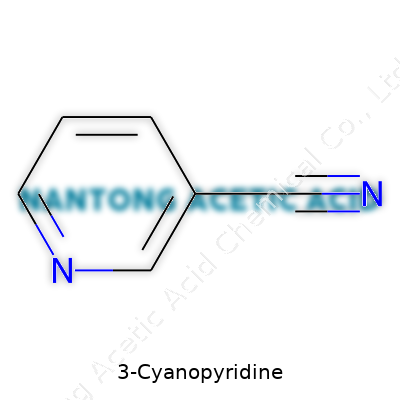
Anyone who's ever taken apart an old radio to see the wires and gears inside can appreciate what it's like to look at the chemical structure of a compound. With 3-cyanopyridine, the beauty actually lies in its simple, compact arrangement. We're talking about a molecule with a pyridine ring—a classic six-membered aromatic shape made from five carbons and a nitrogen. Right on the third carbon, there's a group that chemists call "cyano"—a carbon triple-bonded to a nitrogen.
Drawing this one out in the lab, the pyridine’s nitrogen sits at the first position, and the cyano group attaches to the third carbon if you number counterclockwise. Not just a random attachment, the cyano group drastically changes how this molecule behaves. Aromatic rings often bring to mind stability, but tossing a cyano group into the mix cranks up the reactivity and versatility.
3-Cyanopyridine matters a lot to folks in both research and manufacturing. The positioning of that cyano group unlocks a pathway for all sorts of chemistry. Other nitriles, like benzonitrile, come up all the time in undergraduate labs, but putting it on the pyridine ring unleashes a toolkit for synthesis. One huge point: chemists use it as a stepping stone to make vitamin B3 (nicotinic acid) on a very large scale. Through a simple hydration reaction (adding water), you yank that nitrogen in the cyano group off and get nicotinic acid, which keeps more than just food manufacturers busy—public health depends on it.
Folks don’t always think about how making vitamins or medicines depends on a subtle shift in a molecular diagram. Most people only see the final pill or powder. That straightforward-looking cyano group on the ring acts like a Swiss Army knife—it’s a handle for building all sorts of molecules, from agrochemicals to pharmaceuticals. Safety, accessibility, and even the economies of entire regions ride on the backbone of skeletal formulas like this one.
Checking the global supply chain for precursors like 3-cyanopyridine, you find a mix of modern chemical production and careful handling. Workers routinely encounter specific protocols, since both pyridine derivatives and nitriles can irritate if not handled right. Chemical plants in places with strong worker safeguards cut down on incidents, but the story varies from site to site.
Waste is another piece of the puzzle. Efforts to catch and recycle solvents like ammonia and to minimize unwanted byproducts go hand in hand with newer, cleaner catalytic processes. Water use, safety practices, and emission controls set the high bar for responsible production. Skipping these basics isn’t just risky—it invites real consequences for neighbors and the broader ecosystem.
Research keeps pushing for greener synthetic routes, both to save money and to keep environmental harm down. One interesting example: microbial biotechnology, which nudges certain bacteria to create 3-cyanopyridine under mild conditions. Instead of smokestacks and complex machinery, vats of microbes can churn through the same reactions with less waste, often at a competitive cost. Funding and patience are hurdles, but the field offers legitimate hope.
Chemical structure often gets overlooked in debates about health, supply chains, or innovation. Yet, for 3-cyanopyridine, that tiny sticker of a cyano group opens up an array of opportunities, reminding us that even slight tweaks in molecular architecture ripple out into the world well beyond the bench.
3-Cyanopyridine, a pale yellow to white solid, often turns up in labs and factories without much fanfare. Many who cross paths with it notice the sharp, sometimes jungle-like odor that comes with being a nitrile. This isn’t just a nuisance; that smell gives a hint about its chemical character and volatility. Not all compounds come with a scent you want to avoid lingering near, but this one sends a clear message.
Anyone who’s handled pyridine chemicals sees the family resemblance—flat ring, nitrogen tucked in, but 3-cyanopyridine wears a cyanide group at the third carbon. This seemingly small change sets off ripple effects in its behavior. That nitrile group doesn’t just add a layer to the aroma; it bumps up the boiling point and splashes some extra polarity into the mix. Water doesn’t dissolve it well, but organic solvents gobble it up easily. Using it in the lab, I learned quickly that handling and storage must respect this reactive side—pyridine base reactions, especially, can bite back if treated lazily.
You rarely find 3-cyanopyridine flying solo. Factories convert it into nicotinamide almost routinely, and that’s a building block for vitamin B3. For anyone tracking nutrition or supplement safety, realize that millions benefit daily from chemistry that uses this nitrile. It feeds into pharmaceuticals, agrochemicals, dyes, and specialty polymers. Europe and East Asia ramped up production to support food fortification programs and animal feeds. In factories, it’s not the final stop—it’s a connector. Modern supply chains lean hard on chemicals that can handle both heat and catalytic transformations, making 3-cyanopyridine a favorite.
Run-ins with 3-cyanopyridine raise important safety flags. As with most nitriles, there’s toxicity lurking. Inhalation, skin contact, or poor lab habits have consequences. Workers with years in chemical production keep gloves on and fume hoods running not just because rules say so, but because they know firsthand the impact of accidental exposure. Acute effects might show up as irritation, but extended exposure tips toward more serious health risks. In the past, loose storage and improper venting led to incidents, fueling stricter protocols.
Many in chemical manufacturing push for greener, safer syntheses and cleaner byproducts. Some labs use biocatalysts to swap out harsh reagents, and investments in closed systems now cut down on emissions. International guidelines push for training and regular monitoring, but the real test comes down to everyday choices and vigilance inside the plant or lab. As regulators look closer at chemicals that could impact air and waterways, expecting more innovation in purification and waste handling makes sense.
3-Cyanopyridine started as a mere chemical curiosity. Its journey through industry, nutrition, and pharmaceutical research proves that even the common-seeming molecules have stories of risk, benefit, and the need for respect. The job isn’t just about making or using it, but making sure people and places stay protected while science and industry move ahead.
Walking into a chemistry lab, the whiff of a strong-smelling chemical, or a powder you haven't worked with before, always puts people on alert. 3-Cyanopyridine is one of those chemicals. It's not notorious like cyanide, but it isn't harmless either. Too many folks I know brush off protective gear, assuming a splash or sniff won't matter much, but with things like 3-Cyanopyridine, that's a mistake you only make once.
There's a solid reason chemists pay close attention to the safety data sheets and actual stories of exposure, not just the technical names or numbers. 3-Cyanopyridine can irritate the skin, eyes, and respiratory system, so respect for those risks stays front-of-mind after seeing a colleague get teary-eyed and lightheaded from a careless spill. Eye and skin contact stings — and those who have worked with it without gloves or goggles usually wind up regretting that decision quickly. Workbench legends aren’t urban myths.
Imagine working in a lab with poor ventilation on a hot day, and you’re weighing out a solid that throws up a little invisible cloud. The nose and lungs can tell the difference right away. Inhaling dust or fumes from 3-Cyanopyridine doesn’t just irritate; it can set off headaches or even trigger asthma. Proper ventilation — real, working fume hoods, not just a cracked window — keeps those risks in check. Mask up, even if the job seems quick. Disposable masks won’t do much; use a real respirator if dust or vapors are possible.
I learned the hard way in graduate school that street clothes won’t protect you from chemical burns. For 3-Cyanopyridine, it makes sense to go with chemical-resistant gloves, lab coats, and good-quality goggles. This isn’t overkill. Even experienced techs slip up, and a splash or unexpected cloud needs to hit a shield, not skin. Shut-toe shoes, sleeves that cover the wrist, and tying back loose hair might sound basic, but these basics keep burns and rashes at bay. The best labs I’ve seen run short pep talks that remind staff and visitors what gear they should wear, and the message sticks.
Clean workspace habits matter as much as gloves and goggles. Never open 3-Cyanopyridine outside a fume hood or designated area. Label containers clearly so nobody grabs the wrong jar, and store the chemical tightly sealed. Wipe up spills as soon as they happen, using proper materials — paper towels just spread fine powder around. Watching someone toss contaminated gloves in the basic trash, or pour leftover solution down the drain, reminds everyone of why spill kits exist. Dispose of waste in line with hazardous protocols to avoid surprises down the road.
I’ve seen honest mistakes become scary incidents because someone skipped training or figured those few minutes didn’t matter. Onboarding every new hand with a walk-through of chemical handling goes much further than a folder of written rules. Drills, real-world scenarios, and open talk about near-misses create a safer culture. If anything about a process feels wrong or unclear, speak up or step back. I’ve learned more from open conversations after a close call than from any rulebook.
Staying safe with 3-Cyanopyridine isn’t complicated, but it demands a real commitment. Taking the extra step with gear, airing out the space, and nailing the basics of labeling and disposal makes the difference between smooth work and a trip to the clinic. Respect for the material, learned from experience, is the surest safeguard around chemicals that only look harmless.
Seeing how 3-cyanopyridine fits into modern manufacturing always takes me back to my early days in the lab. This compound doesn’t always steal the headlines, but it matters to everyone who takes vitamins, grows crops, or steps into a pharmacy. You’ll find it used in pharmaceuticals and agriculture, making its journey from chemical curiosity to industrial staple important for everyday life.
Many factories rely on the ammonoxidation process to synthesize 3-cyanopyridine. Chemists figured out that by passing 3-methylpyridine (also called 3-picoline) over a catalyst in the presence of ammonia and air, they could make the nitrile group stick where they wanted. Compared to alternatives, this route wastes less and keeps emissions in check—both things that matter for environmental health. From what I've seen, this approach also runs on a large scale at reasonable cost.
This approach isn’t just lab theory—it’s the backbone of commercial production. Companies look for catalysts that boost performance but stay stable; many turned to vanadium-based and molybdenum-based catalysts, since they keep conversion rates high and last long without frequent swap-outs. In practical terms, that means more product and less downtime. This process isn’t without risk; working with ammonia and oxidizing conditions takes careful handling and safety measures. Well-run plants recognize that, with strict protocols to prevent leaks or burnout.
Experienced operators always keep their eyes on waste streams. Feedstocks like 3-methylpyridine can leave behind unwanted substances, and side products pile up without precise temperature and pressure control. Most facilities reuse or recover what they can, turning a potential problem into extra value. This approach matters if we’re serious about keeping groundwater and air clean, as I’ve seen how quickly waste management headaches can spiral into community concerns. It's always easier to handle a challenge at the source than to try to clean up after the fact.
Despite the progress made, the industry faces plenty of challenges. The market for 3-cyanopyridine pushes companies to run plants harder, sometimes pushing the limits of what equipment and catalysts can take. As governments and consumers call for greener chemistry, some labs are exploring biotechnological methods using engineered enzymes or microbes. Early data shows these methods might run at lower temperatures and use less hazardous chemicals. A few years ago, nobody in the field would have guessed bacteria could help make a complex chemical, yet this idea is gaining real ground.
Sustainable production of chemicals like 3-cyanopyridine isn’t just about economics—it’s about trust and stewardship. My own experience in plant operations taught me that cleaner processes lead to better worker morale and fewer community complaints. There’s more at stake than product yield; people want to know their medicines and food additives come from sources that respect both health and the planet. Staying transparent about how chemicals get made and pushing new technology forward keeps the industry honest and builds a future we can all count on.